
Every marketing legend has a moment where everything could have gone sideways. One wrong word, one misplaced comma, one overlooked detail that transforms a billion-dollar campaign into advertising graveyard fodder.
The “Got Milk?” campaign wasn’t just born from creative genius: it survived a series of near-misses that almost killed it before it ever saw a billboard. What most people don’t realize is how close this iconic slogan came to being something completely forgettable, and how the smallest details can make or break campaigns worth hundreds of millions.
The Room Where It Almost Didn’t Happen
Picture this: 1993, Goodby Silverstein & Partners in San Francisco. The California Milk Processor Board is hemorrhaging market share as consumers ditch dairy for alternatives. Traditional milk advertising was failing spectacularly.
Instead of another wholesome farm-to-table campaign, creative director Jeff Goodby had a radical idea. What if they focused on the moment you don’t have milk instead of celebrating when you do?

The breakthrough came during a focus group session that nearly went off the rails. Participants were asked about their milk consumption habits, but the real insight emerged when someone mentioned that terrible feeling of reaching for milk and finding an empty carton.
That’s where colleague Tara Winkler made the difference. During a brainstorming session, Goodby casually mentioned wanting to capture that “running out of milk” feeling. Winkler grabbed a piece of foam core and scribbled down two words with a question mark: “Got Milk?”
The Details That Almost Killed a Legend
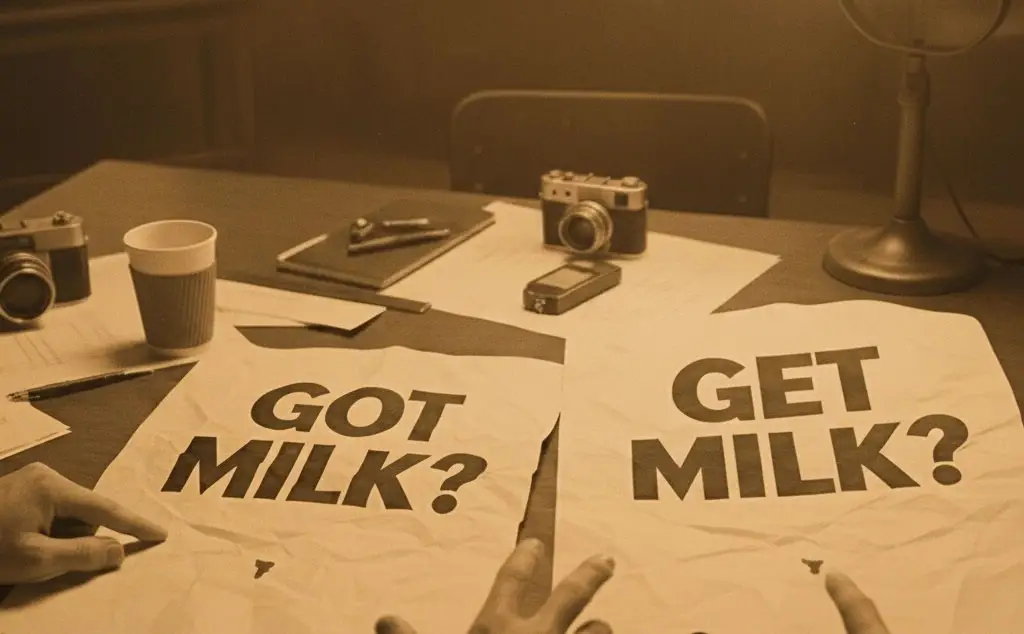
Here’s what almost derailed everything: the punctuation.
The original concept bounced between “Got Milk” as a statement and “Got Milk?” as a question. Internal debates raged over whether the question mark made it too casual, too informal for a serious advertising campaign targeting health-conscious consumers.
Focus group moderators initially hated the question format. They argued it sounded like slang, like something teenagers would text each other rather than a professional advertising campaign. Some executives pushed for “Do You Have Milk?” or “Have You Got Milk?” as more grammatically correct alternatives.
The typography team spent weeks testing different font treatments. One version had the question mark so small it was barely visible. Another made it so large it dominated the text. A simple punctuation mark was threatening to sink months of strategic work.

When Deprivation Became Marketing Gold
The genius of “Got Milk?” wasn’t just the slogan: it was the strategy shift from promotion to deprivation. Traditional dairy advertising focused on milk’s benefits: calcium, vitamins, wholesome nutrition. This campaign flipped the script entirely.
The first commercial proved the concept worked. A businessman in an apartment filled with historical memorabilia receives a radio call asking about the duel between Aaron Burr and Alexander Hamilton. He knows the answer: Hamilton: but his mouth is full of peanut butter sandwich and he has no milk to wash it down.
When he tries to say “Aaron Burr,” it comes out as unintelligible mumbling. The radio host hangs up. The man frantically searches his refrigerator, but the milk carton is empty. Cut to black. “Got Milk?”
That single commercial generated more brand awareness in three months than the previous five years of traditional milk advertising combined.
The Typography Mistake That Made Millions
The final “Got Milk?” logo almost looked completely different. The original design featured serif fonts that tested poorly with focus groups. Participants described it as “old-fashioned” and “stuffy”: exactly what the campaign was trying to avoid.
A last-minute switch to a clean, sans-serif typeface saved the entire visual identity. The new font felt modern, approachable, and perfectly matched the conversational tone of the question mark.
But here’s the detail that almost ruined everything: spacing. Early versions had too much space between “Got” and “Milk,” making it read like two separate thoughts instead of one cohesive phrase. A simple kerning adjustment made the difference between forgettable and iconic.

From Regional Campaign to Cultural Phenomenon
The California Milk Processor Board initially budgeted for a modest regional campaign. Nobody anticipated the cultural explosion that followed.
Within six months, “Got Milk?” merchandise was selling faster than actual milk. T-shirts, mugs, bumper stickers: the slogan transcended advertising to become pop culture shorthand.
The celebrity milk mustache ads elevated the campaign to legendary status. When celebrities like Naomi Campbell, Jennifer Aniston, and later, numerous sports stars appeared with milk mustaches, the campaign achieved something most advertising never does: cultural permanence.
Each celebrity shoot required meticulous planning. The “milk mustache” wasn’t real milk: it was a carefully crafted mixture that would photograph perfectly under studio lights without spoiling or looking unnatural.
The Numbers That Prove Small Details Matter
The “Got Milk?” campaign reversed a 20-year decline in milk consumption. Sales increased by 7% in California within the first year: the first increase in two decades.
National expansion through MilkPEP brought the campaign to all 50 states. Over its lifetime, the campaign generated more than $500 million in additional milk sales.
But the real measure of success? Cultural impact. “Got [blank]?” became a meme format decades before memes had a name. From “Got beer?” to “Got Bitcoin?”, the structure became advertising shorthand for desire and scarcity.

Lessons Every Brand Can Apply Today
The “Got Milk?” success story teaches us three critical lessons about campaign development:
First: Question everything, especially punctuation. That question mark transformed a statement into a conversation. It made the audience active participants instead of passive recipients.
Second: Test the details obsessively. Typography, spacing, color, timing: every element matters. What seems like a minor adjustment can determine whether your campaign gets remembered or ignored.
Third: Embrace strategy shifts that feel risky. Moving from promotion to deprivation went against decades of dairy advertising wisdom. Sometimes the biggest risks generate the biggest rewards.
Why Attention to Detail Separates Winners from Losers
The difference between campaign success and failure often comes down to seemingly minor decisions made in conference rooms most people never see. The teams that sweat the small stuff create the campaigns that change industries.
At The Wann Agency, we’ve seen brilliant creative concepts die because someone overlooked a crucial detail in execution. We’ve also witnessed mediocre ideas become market leaders because every element was perfectly calibrated.
We turn ruthless attention to detail into breakthrough strategy and results. We pressure-test creative from brief to billboard—merging audience insight, positioning, and message architecture with on-brand design systems, typographic and spacing standards, motion timing, and previsualized storyboards. Our process includes asset preflight, ADA/contrast compliance, and disciplined multi-variant testing across Meta Ads Manager, Google Ads, YouTube, and programmatic to perfect the fine points others miss and transform strong ideas into cultural touchstones.
Ready to build work people remember and repeat? Partner with The Wann Agency to sharpen the details, prove the strategy, and launch your next iconic campaign.
SEO Tags
branding agency, marketing agency, brand storytelling, visual branding, creative design services, marketing leadership, business marketing tools, marketing support, strategic marketing guidance, brand community, brand loyalty, brand campaign, iconic ads, advertising history, campaign mistakes, marketing wins